

Why Vetiver System Adoption Stalls Worldwide — And How to Fix It

Why the World's Most Proven Erosion Solution Still Can't Get a Meeting

The hard truth about vetiver system adoption — and how NbS entrepreneurs can break the institutional inertia.
In 2013, I stood on a stage in Medellín, Colombia, making the case for Vetiver grass as a serious engineering solution to a room full of Latin American delegates and officers. The data was solid. The audience was engaged. People nodded. And still, more than a decade later, most of those same institutions are managing erosion, leachate, and slope failure the same way they always have — with concrete, geotextiles, and chemical treatment trains.
I've spent nineteen years as a civil engineer working with the Vetiver System, promoting it across Latin America and Australia. I've watched Dr. Paul Truong personally brief Australian councils and government agencies for decades. I've seen the plant solve landfill leachate problems, stabilise slopes that engineered walls couldn't hold, and treat industrial wastewater at a fraction of conventional cost. And I've watched almost every one of those wins stay a one-off.
Here's the paradox that's been sitting with me for long time:
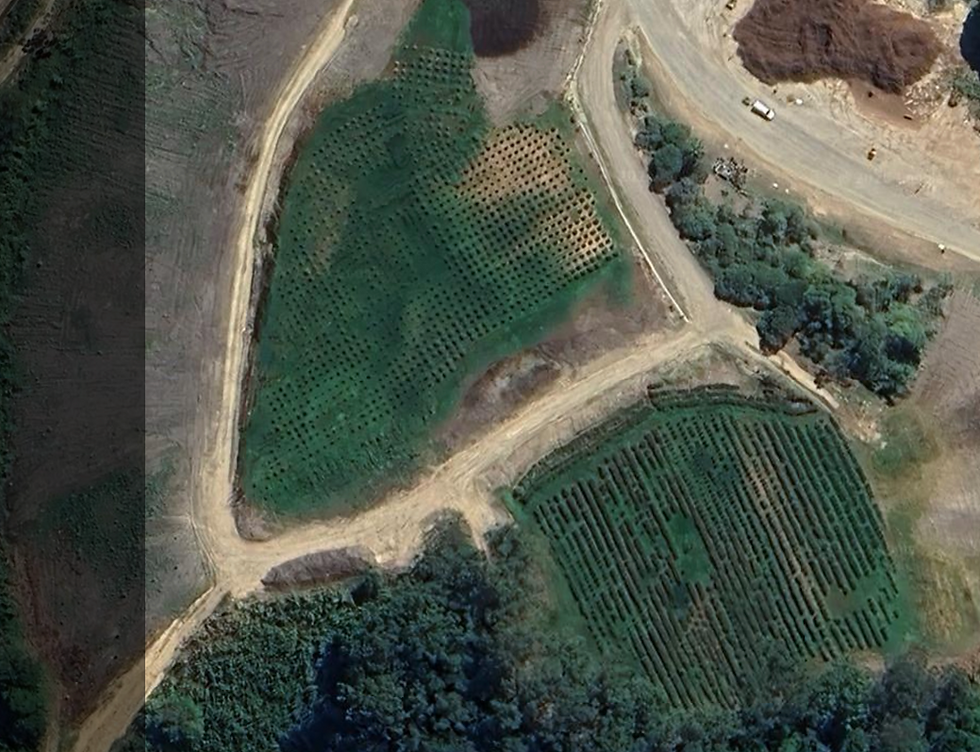
The Stotts Creek Paradox: 23 years of continuous, regulatory-approved performance data at landfill scale. Yet it remains — as far as I know — the only landfill in Australia applying the Vetiver System at this level. Twenty-three years of proof, and still no second site. How is that even possible?
The Pattern Isn't Unique to Vetiver Systems
If you work in Nature-based Solutions (NbS) — Vetiver, wetlands, bioswales, living shorelines, whatever your version is — this will sound familiar. The technology outperforms on paper. It often costs less over its lifecycle. It solves problems that conventional engineering treats as separate line items. And it still can't get past the procurement stage.
The Core Barriers to Nature-Based Solutions
This isn't a coincidence, and it isn't really about the plant or the solutions. Research into nature-based solutions adoption consistently points to the same handful of blockers: no standardised regulatory pathway for approving them, a shortage of professionals trained to design and specify them with confidence, and decision-makers who default to what's familiar because the risk of an unfamiliar failure feels larger than the risk of a familiar one — even when the familiar option's own performance is weaker. On top of that, financing models built for capital-intensive concrete and steel infrastructure simply don't fit a living, distributed, low-capex solution — so the money follows the grey infrastructure by default, not because it performs better.
The Part We Don't Say Out Loud
There's a second layer, and it's worth naming plainly rather than dancing around it. Grey infrastructure — concrete, steel, engineered drainage — is backed by enormous, established industries with a rational economic interest in maintaining the status quo. That's not a conspiracy theory; it's ordinary Economics. Industries with capital sunk into one way of doing things have a rational interest in that way of doing things staying the standard, and that shows up in building codes, tender specifications, and what gets taught in engineering programs. None of this requires bad faith from any individual engineer or council officer — it's structural, not personal. But if you're promoting a nature-based alternative, you're not just making a technical case. You're asking someone to step outside a system that has a lot of institutional weight behind keeping things as they are.
Why "Miracle Plant" Makes It Worse, Not Better
Here's where I think those of us promoting Vetiver — myself included, for years — have made the job harder than it needed to be. When you present Vetiver as a single input that fixes erosion, leachate, agricultural issues, wastewater, and slope failure all at once, you trigger a very specific and very reasonable scepticism reflex. Anyone trained to evaluate infrastructure risk is trained to distrust a solution that claims to do everything. It doesn't matter that the underlying plant science is genuinely sound — the breadth of the claim itself reads as a red flag, before anyone even looks at the data.
That reflex isn't stupidity or closed-mindedness on the part of the engineer, the council officer, or the policymaker reviewing the proposal. It's a sensible filter against a certain kind of pitch. The problem is we've been making that pitch.
What Actually Needs to Change
If you're a Vetiver entrepreneur anywhere in the world — India, Panama, Kenya, Australia, it doesn't matter — the fix isn't more evidence about the plant. The evidence has been sitting at Stotts Creek for 23 years and it hasn't moved the needle on its own inside the Australian Waste industry. The fix is in how the case gets built.
Stop selling the plant. Sell the outcome, in the buyer's own language:
Council officers want proven erosion control that fits existing procurement and compliance frameworks.
Landfill operators want leachate managed within EPA licence conditions at lower long-term cost.
Industrial water managers want defensible, regulator-approved treatment performance.
None of them are shopping for a "miracle plant" — and if that's what you're selling, you've already lost the room, no matter how good your data is.
Key takeaway:
"Vetiver is the mechanism, not the headline. Introduce it after the problem is on the table and the outcome is agreed — not before."
Save the full, multi-application story for the audience that's already there for the plant science itself: researchers, fellow practitioners, the TVNI network. Everyone else needs the solution first.

Where This Leaves Us
Twenty-three years at Stotts Creek should have been enough to change an entire industry's default. It wasn't — not because the system failed, but because proof alone doesn't move institutional inertia, and "look how much this does" isn't the same argument as "here's how this solves your specific problem." That distinction is the entire game for anyone trying to build a Vetiver business today.
Here's the encouraging part: it does move, when enough promoters push in the same direction. Colombia is a live example. Vetiver System is now used for erosion control on road infrastructure there quite widely — a direct consequence of years of collective effort, not one person's pitch. I worked alongside my father to get it institutionalised inside INVIAS, Colombia's national road institute. After that 2013 conference and a lot of ongoing lobbying, it was written into the national guide and national tenders. It's recognised there now, though there's still plenty of work left inside that system, and the other applications — leachate, wastewater, PFAS — haven't caught up yet in that market.
That's the model. Not one heroic case study sitting on its own, but enough of us pushing the same problem-first argument, in enough rooms, until it becomes the default. If you're working to build Vetiver adoption in your own country or region and you're running into the same wall I hit in Medellín in 2013, get in touch. I'd rather compare notes than watch another decade of good data sit next to a single case study.
Reach out directly at Vetiverse.org — I read and reply to every message.
Daniel Londono —
Founder & Director, Vetiverse.org.


Comments