

Vetiver Grass for Flood Prevention: The Nature-Based Solution Australia Needs |

Floods are among the most destructive forces on earth. They erase topsoil, undermine roads and bridges, contaminate waterways, and displace communities — often in hours. As climate change intensifies rainfall events and extends wet seasons across Australia and globally, the pressure on flood management infrastructure is only growing.

Traditional responses — concrete channels, levee banks, detention basins — remain part of the toolkit. But they are expensive to build, expensive to maintain, and ecologically blunt. There is increasing recognition, from engineers to government planners, that nature-based flood solutions deserve a central place in the response. Vetiver grass is one of the most effective and underutilised of these solutions. This article examines what Vetiver grass actually does in a flood context, why it outperforms many conventional approaches on a lifecycle basis, and how to deploy it effectively across Australian landscapes and infrastructure corridors. What Are Nature-Based Flood Solutions?
Nature-based solutions (NbS) use or mimic natural processes to address environmental challenges — in this case, flood risk. Rather than redirecting or containing water through hard engineering, NbS approaches work with the landscape to slow water movement, increase infiltration, trap sediment, and reduce peak flows. Examples include riparian revegetation, constructed wetlands, floodplain restoration, and vegetated bioswales. Vetiver grass fits squarely within this category, but with a critical advantage over many alternatives: it is exceptionally robust, fast-establishing, and does not require ongoing inputs once mature.
The growing interest in NbS reflects both mounting evidence of their effectiveness and a recognition that hard infrastructure alone cannot keep pace with the scale or cost of climate-related flood risk. The 2022 South-East Queensland and Northern Rivers floods — among the most costly in Australian history — demonstrated the limits of engineered flood control in the face of extreme precipitation. Complementary, landscape-scale approaches are no longer optional; they are essential.
Why is vetiver grass the nature-based solution Australia needs for flood prevention?
The Biology Behind the Performance Vetiver grass (Chrysopogon zizanioides) is native to India and has been used systematically for erosion control and land rehabilitation for over three decades, documented across more than 100 countries. It is not a new discovery — it is a proven technology that remains underused in many contexts where it would deliver clear results.
Its flood and erosion control performance comes from a specific combination of biological characteristics:
• Root architecture: Vetiver’s root system grows vertically, not horizontally, reaching 3–4 metres in depth within two to three years. This anchors the plant firmly in unstable soils and creates a dense, fibrous matrix that binds soil particles against the shear forces of flowing water.
• Above-ground structure: Dense hedgerow plantings act as semi-permeable barriers — they slow water, allow it to pass through at reduced velocity, and cause suspended sediment to drop out. This is fundamentally different from Impermeable barriers, which redirect pressure rather than dissipate it.
• Tolerance range: Vetiver thrives in conditions that eliminate most other species — extended drought, waterlogging, pH from 3.0 to 10.5, high salinity, heavy metal contamination, and temperatures from below zero to over 45°C. This means it performs in the conditions most likely to be associated with flood and post-flood stress.
• Non-invasiveness: Vetiver does not spread via runners, stolons, or seed dispersal under normal conditions. It stays exactly where it is planted, which makes it suitable for sensitive environments and eliminates the management burden associated with many other grass species. These characteristics combine to make vetiver one of the most predictable and reliable biological tools available for landscape-scale flood risk reduction.

How Vetiver Reduces Flood Risk in Practice
The flood risk reduction mechanisms of vetiver operate at multiple scales simultaneously. At the slope and paddock scale, vetiver hedgerows planted on contour lines intercept surface runoff before it can concentrate and accelerate. Research from Queensland farming contexts has documented soil loss reductions of over 70% in paddocks managed with vetiver contour hedges, compared to unprotected slopes. Reduced surface runoff means less water entering drainage systems rapidly — which directly lowers peak flow levels in downstream waterways.
At the riverbank and drainage corridor scale, vetiver’s root system stabilises the soil profile against the scouring action of high-velocity floodwater. Riverbank erosion is a major secondary consequence of flooding — it widens channels, increases sediment loads, and undermines riparian infrastructure. Vetiver hedgerows planted along banks and in drainage easements provide continuous root-and-stem resistance that concrete revetment cannot match for cost or ecological function.
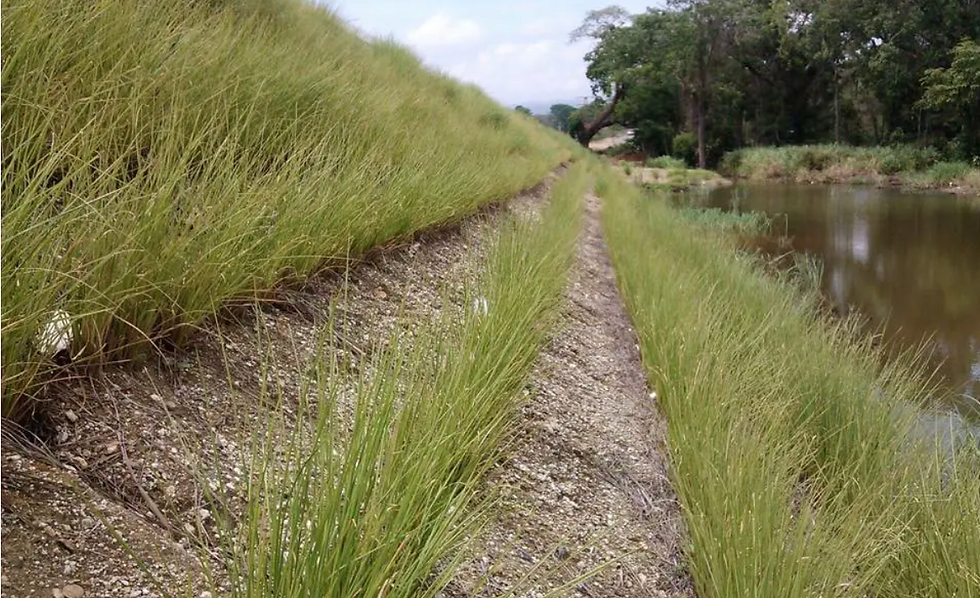
At the infrastructure scale, road embankments, highway batters, railway cuttings, and stormwater channels are among the most vulnerable assets in a flood event. Soil saturation followed by high-velocity surface flows strips unprotected batters rapidly. Vetiver planted on these surfaces creates a living skin that holds the soil matrix in place through the event and recovers quickly afterward, reducing both the frequency and cost of maintenance interventions.
Vetiver and Water Quality
Flooding does not only damage physical infrastructure — it degrades water quality across entire catchments. Surface runoff carries sediment, nutrients, pesticides, heavy metals, and pathogens from agricultural land, industrial sites, and urban areas into waterways and groundwater systems.
Vetiver addresses this through two mechanisms. First, by slowing and spreading surface flows, it causes suspended particles to settle out before reaching waterways — functioning as a distributed, landscape-scale sediment filter. Second, the plant itself has documented phytoremediation capacity: it absorbs heavy metals, phosphorus, nitrogen, and some persistent organic compounds through its root system.
This is not a marginal effect. In mine rehabilitation contexts in Western Australia and Queensland, vetiver has been used to stabilise tailings dams and reduce heavy metal concentrations in runoff. In agricultural settings across New South Wales, vetiver hedges have measurably reduced pesticide and nutrient loads entering watercourses. In the context of landfill leachate management — an area of longstanding application documented by The Vetiver Network International (vetiver.org)— vetiver has been shown to process contaminated leachate at rates that rival engineered treatment systems, at a fraction of the cost.
For councils and catchment managers dealing with flood aftermath, this matters: the first flush of post-flood runoff is typically the most contaminated. Vetiver across the catchment reduces the pollutant load before it reaches the system.
Practical Deployment: What Works in the Field
Effective vetiver implementation for flood risk reduction follows a clear process. The details matter — poorly designed or poorly established plantings underperform.
• Site assessment: Identify the critical flow paths, erosion hotspots, and infrastructure assets at risk. Aerial imagery and LiDAR data are useful where available; field observation is essential. Understand soil type, slope gradient, and seasonal water behaviour before designing a planting layout.
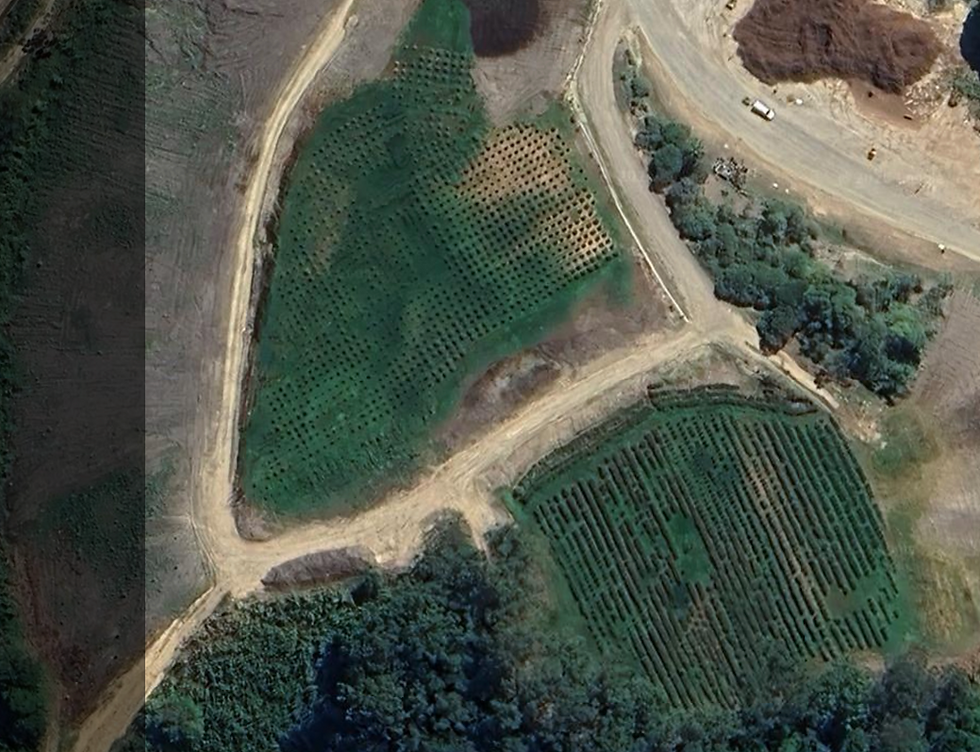
• Planting design: Hedgerows are typically planted in rows spaced 15–20 cm apart within the row, on contour lines on slopes. Multiple parallel rows increase performance on steeper gradients. On embankments and batters, staggered rows provide continuous coverage. Spacing and layout should be designed to the specific hydraulic conditions of the site.
• Establishment: Vetiver is planted from slips (vegetative divisions), not seed. The first 3–6 months require attention — adequate soil moisture, weed control, and replacement of failed plants. Once the root system is established, the plant is largely self-sustaining. This establishment window is the primary cost centre of a vetiver project.
• Maintenance: Mature vetiver hedges require minimal intervention. Periodic slashing or trimming maintains hedge density and prevents shading out. Gaps from damage or vehicle strikes should be replanted promptly to maintain continuity of the barrier.
• Monitoring: Track establishment progress, hedge density, and post-event condition. In high-value infrastructure contexts, photographic monitoring after significant rainfall events provides useful evidence for asset management records and informs any replanting needs.
Cost-Effectiveness Over the Asset Lifecycle
One of the persistent barriers to adoption of vegetative approaches in infrastructure contexts is the upfront cost comparison with conventional methods. This comparison typically ignores lifecycle costs, which is where Vetiver Systems performs most compellingly.
Hard engineering solutions — concrete channels, gabion walls, riprap revetment require ongoing inspection, repair, and eventually replacement. Their performance degrades over time; their ecological function is near zero. A vetiver hedge, once established, improves with age. Root depth and density increase over years, delivering progressively better performance. Maintenance costs after establishment are minimal.
For local governments and asset managers working within constrained maintenance budgets, this matters significantly. A 2-kilometre stretch of highway embankment revegetated with Vetiver Systems will cost less to maintain over a 20-year period than the same stretch managed with conventional erosion control matting and periodic regrading — and will perform better in extreme events.
The economic case is further strengthened when water quality benefits are factored in. Reduced sediment and nutrient loads in downstream waterways lower treatment costs for water utilities and reduce dredging requirements in reservoirs and harbours.
These are real cost savings that are rarely attributed back to the upstream intervention that caused them.
Challenges and Realistic Expectations Vetiver is not a universal solution, and it is important to be clear about its limitations.
Establishment requires time. A newly planted hedge provides minimal protection in the first season. For sites with immediate high-risk exposure, Vetiver should be used alongside short-term stabilisation measures during the establishment period.
Extremely saline soils can limit establishment success, though Vetiver’s tolerance range is considerably broader than most alternatives. Site specific assessment is important before specifying it in marginal conditions.
Design matters. Vetiver planted incorrectly — wrong spacing, wrong alignment relative to flow direction, insufficient density — will underperform. Engaging practitioners with direct field experience in the specific application type is worth the investment.
None of these are reasons to avoid it. They are reasons to deploy it well.
The Case for Mainstreaming Vetiver in Flood Management
Australia faces an intensifying flood risk profile. The economic cost of flooding estimated in the billions annually and rising — is not going to be addressed by hard engineering alone. Nature-based flood solutions need to be integrated into mainstream planning, not treated as an experimental fringe.
Vetiver grass is one of the most rigorously documented, field-tested, and cost- effective tools in this category. It has decades of evidence behind it, a global practitioner network (vetiver.org), and a performance record across some of the most demanding environmental conditions on earth.
The gap is not evidence. The gap is awareness and application.
At Vetiverse.org, we work with councils, engineers, land managers, and asset owners to design and implement Vetiver System solutions that are properly specified for the site and purpose. If you are dealing with flood risk, erosion, contaminated runoff, or the ongoing cost of maintaining vulnerable infrastructure, it is worth a conversation.
Daniel Londono
Founder & Director, Vetiverse.org
International Coordinator, The Vetiver Network International (vetiver.org)
Tags: nature-based flood solutions, vetiver grass flood control, vetiver erosion control Australia, flood prevention plants, NbS flood management, Vetiver System

Comments