

What 20 Years of Vetiver Systems in China Tells Us About What's Possible in Australia

Published by Vetiverse.org | Vetiver System Knowledge & Advocacy
When the World Bank (Richard Grimshaw) introduced the Vetiver System to China in 1988, it began as a modest agricultural trial across five southern provinces. Two decades later, it had been written into national railway regulation, deployed across 1.8 million square metres of highway slopes in a single province, and formally adopted by provincial highway bureaus as standard embankment technology.
That trajectory — from demonstration plot to government mandate — is one of the most instructive stories in applied bioengineering. And it holds a direct lesson for Australia.

From Paddock Trials to National Policy: The Chinese Experience
Dr Liyu Xu, Coordinator of the China Vetiver Network, documented this story in a 2009 Pacific Rim Vetiver Network technical bulletin. What he describes is not a niche experiment. It is a systematic, evidence-based rollout that moved across agriculture, civil infrastructure, mine rehabilitation, and environmental management — with documented results at each stage.
In Jiangxi and Guangdong provinces, vetiver hedges reduced surface runoff by 32–60% and cut soil erosion by 64–93% compared to unprotected control plots. On highway embankments in Fujian Province, vetiver-protected slopes cost between one-sixth and one-eighth of equivalent rock or rock-and-cement protection — not marginally cheaper, dramatically cheaper. In Jiangxi, vetiver fully stabilised embankments on Wuyi Mountain within four months of planting, on slopes of granite parent material ranging from 30° to 60°, at elevations up to 750 metres above sea level.
By 2001, the Vetiver System had been formally included in China's National Railway Embankment Protection and Greenisation Regulation — meaning vetiver was no longer optional guidance. It was the standard.
In Zhejiang Province alone, 640,000 square metres of highway slopes were stabilised with vetiver, saving a minimum of 25 million yuan compared with hard engineering alternatives.
These are not projections. They are documented outcomes from government road agencies, universities, and research institutes operating under real-world construction conditions.
Beyond Erosion Control: The Full Scope of What Was Demonstrated
One of the most important aspects of the Chinese experience is how broadly the Vetiver System was applied. The common perception — even among engineers — is that vetiver is primarily an erosion control tool. China's 20-year record shows something considerably more versatile.
Mine tailings rehabilitation. Vetiver was successfully established on dolomite slag, carbonised shale, and other hostile substrates in Nanjing where conventional vegetation had failed. Hedges formed within three months. Vetiver's tolerance for wide pH ranges and poor parent materials made it an effective pioneer species — improving microecology sufficiently for other plants to follow.
Wastewater and leachate treatment. Research conducted at Guangdong's Likeng domestic landfill found vetiver more tolerant to concentrated leachate than water hyacinth, bahia grass, and alligator weed — all of which failed or were severely damaged. Vetiver achieved ammoniac nitrogen removal rates of 77–91% and phosphorus removal exceeding 74% in high-concentration leachate. Constructed wetland microcosms with vetiver consistently outperformed those without across COD, nitrogen, phosphorus, and suspended solids metrics.
Eutrophication treatment. Floating vetiver on polluted river and pond water achieved 97% total phosphorus removal and 70% total nitrogen removal within three to four weeks. This has direct relevance to Australia's nutrient-impacted waterways, irrigation drainage systems, and treatment lagoons.
Hydroelectric and dam infrastructure. Vetiver was demonstrated capable of withstanding water flows of 3.5 metres per second at 0.6–0.8 metres depth — making it viable for spillway and dike protection where conventional riparian plantings fail.
Carbon sequestration. The bulletin notes that vetiver's biomass productivity — substantially higher than comparable deep-rooted grasses — positions it as a significant biological carbon sink. With vetiver roots extending 2–5 metres into the soil profile, the carbon fixed below ground is largely protected from oxidation.

The Root System That Changes the Engineering Equation
For practitioners new to vetiver, one specification deserves particular attention: the tensile strength of vetiver's root system has been measured at 40–120 MPa, with an average of 75 MPa. That is approximately one-sixth the ultimate tensile strength of steel — and measurably higher than the mechanical tensile strength of most trees and shrubs.
Roots penetrate 2–3 metres as standard, with documented cases reaching 5.2 metres. Unlike trees, which concentrate root mass in the upper soil profile, vetiver's root network distributes throughout the soil column, functioning as a distributed reinforcement matrix. It penetrates hardpan layers and has been documented growing through the fine cracks between rock and gravel.
This is why vetiver performs on steep, unstable, and previously unresolvable slopes — not because it is a ground cover, but because it structurally modifies the soil it inhabits.

Vetiver Systems: What This Means for Australia
Australia is not starting from scratch. The Vetiver System has been trialled and documented in Queensland, New South Wales, and Western Australia. The TVNI global case study bank — which Vetiverse draws on as an affiliated knowledge partner — includes established Australian applications.
But the gap between what has been demonstrated and what is being deployed at scale remains significant. China's experience shows exactly how that gap closes: through targeted demonstration projects, cross-sector engagement (agriculture, engineering, environment, and mining in the same conversation), and the credibility that comes from verified, peer-reviewed results.
The Australian contexts where the evidence is strongest and the opportunity is clearest include:
Road and rail embankments. Transport agencies across NSW, Queensland, and Victoria manage thousands of kilometres of cut-and-fill slopes subject to erosion, slippage, and ongoing maintenance cost. The Chinese cost comparison — vetiver at 1/6 to 1/10 the price of rock protection — should be a compelling opening to that conversation, not an afterthought.
Mine site rehabilitation. Australia's post-mining rehabilitation obligations are increasing in regulatory stringency. Vetiver's documented performance on hostile substrates — including acid-generating and nutrient-depleted tailings — makes it a legitimate pioneer species for compliance-driven revegetation programs.
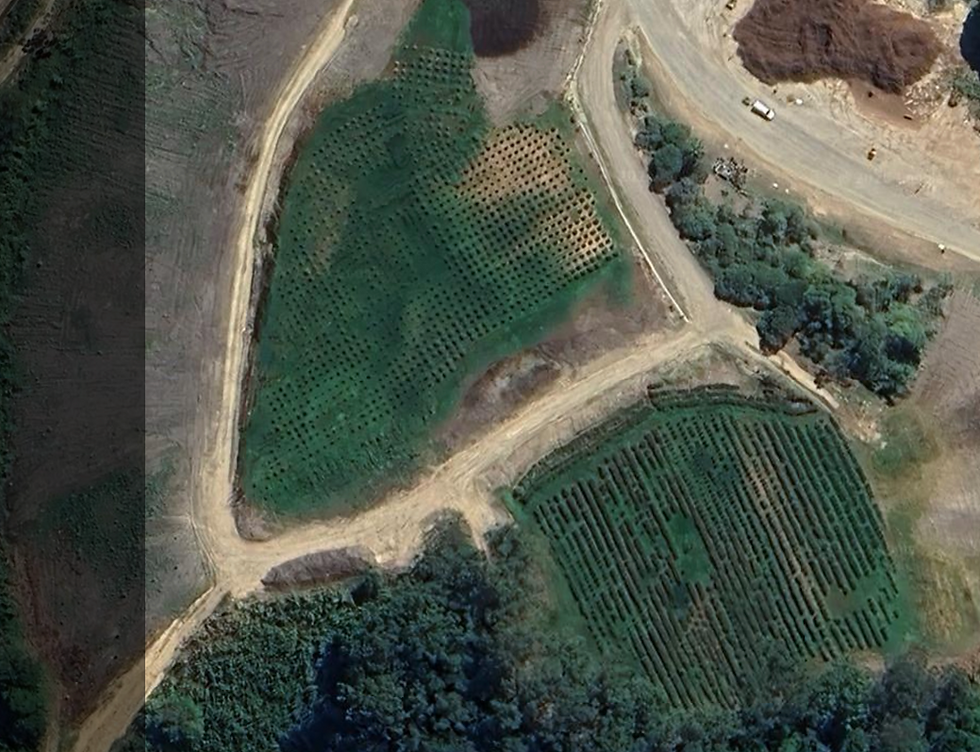
Landfill cap stabilisation. Landfill operators in Australia face significant challenges stabilising final caps on uneven, settling surfaces where conventional vegetation fails to establish. Vetiver's tolerance to concentrated leachate, combined with its root penetration characteristics, makes it highly suited to this application. It is also one of the least contested content gaps in the Australian NbS landscape.
Constructed wetlands and wastewater polishing. Water utilities, local councils, and agricultural operations managing nutrient loads have a documented, low-cost option in floating or planted vetiver systems. The Chinese research confirms removal rates that are competitive with conventional wetland plants — with the added advantage of vetiver's tolerance to high-concentration inputs.
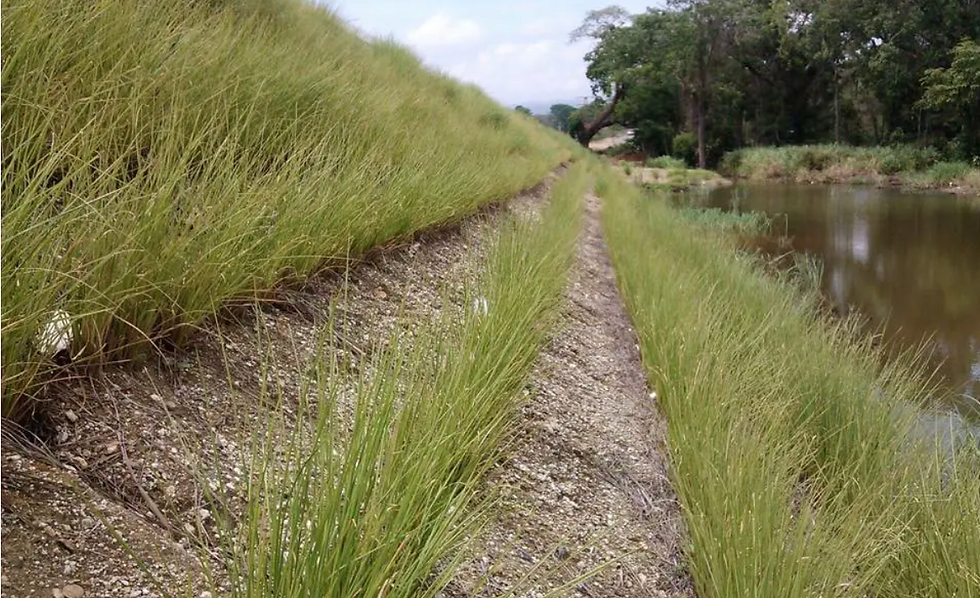
Coastal and riparian bank stabilisation. Northern Rivers, the Kimberley, and tropical Queensland all present active erosion challenges on riverbanks and tidal margins. Vetiver's demonstrated capacity to intercept 7.5–17 kg of silt per linear metre of hedge per year — starting in the first season — is material evidence for NRM bodies evaluating investment options.

The Network Model That Made It Work
One detail from the Chinese experience that often goes unnoticed is the role of the China Vetiver Network (CVN) in translating research into practice. The CVN — established in 1996 with TVNI support — functioned as a connective tissue between universities, government agencies, private companies, and farming communities. It organised conferences, distributed planting material, ran training courses, co-authored publications across disciplines, and created the evaluation events that gave highway and railway agencies the formal confidence to adopt vetiver as policy.
This is the model Vetiverse is building toward in Australia: not simply a plant supplier, but a knowledge and advocacy platform that connects the evidence base with the practitioners who need it. The TVNI affiliation gives Vetiverse direct access to that global case study bank — including the Chinese record — as a credibility foundation from day one.

Getting Started
If you are working in road infrastructure, mine rehabilitation, landfill management, water treatment, or natural resource management in Australia — and you are looking for a cost-effective, evidence-backed nature-based solution — the case for trialling the Vetiver System is well-established.
Vetiverse supplies vetiver planting material, provides technical guidance on establishment and design, and can connect your project with the global TVNI knowledge network.
Contact us at vetiverse.org to discuss a demonstration planting or a site assessment.
Source: Xu, L.Y. (2009). Application and Development of the Vetiver System in China: 20 Year Experience Retrospection. Pacific Rim Vetiver Network Technical Bulletin No. 2009/2. Office of the Royal Development Projects Board, Bangkok, Thailand.
Vetiverse.org is affiliated with The Vetiver Network International (TVNI / vetiver.org) and operates as a vetiver supply, consultancy, and knowledge platform based in the Northern Rivers region of NSW, Australia.
Daniel Londono Vetiverse.org / Founder & Director vetiver.org / TVNI International Coordinator

Comments