

Vetiver Systems Can Treat WasteWater. Here's the Science That Proves It.
- Daniel Londono
- Mar 8
- 10 min read

PHYTOREMEDIATION · WASTEWATER · NATURE-BASED SOLUTIONS
Across the Pacific Islands, Africa, and South America, a humble grass is doing what expensive machinery cannot — cleaning contaminated water without electricity, chemicals, or six-figure infrastructure budgets. This is the story of the Vetiver System as a wastewater solution, backed by two decades of peer-reviewed research.
94% NITROGEN REMOVED BY VETIVER SYSTEM
100+ COUNTRIES WHERE VS HAS BEEN SUCCESSFULLY DEPLOYED AND TESTED
$652B GLOBAL WASTEWATER

The Water Crisis No One Is Talking About Enough
Right now, approximately 2.2 billion people lack access to safely managed drinking water services, according to the World Health Organization. An estimated 80% of the world's wastewater is discharged into the environment without adequate treatment — a figure that climbs to nearly 95% in developing nations where centralised infrastructure is simply out of reach, financially or logistically.
The global wastewater treatment market is valued at over USD $347 billion in 2024 and is projected to reach USD $652 billion by 2034 — yet the communities that need solutions most are the ones least likely to benefit from those high-capital investments. Pacific island nations, sub-Saharan Africa, and rural Southeast Asia face a treatment gap that conventional engineering was never designed to close.
Into this gap steps one of the oldest and most under-appreciated ecological tools in the conservation toolkit: Chrysopogon zizanioides — Vetiver Grass Technology.
"The efficiency of Vetiver improves with time as the vegetative cover matures. Unlike engineering structures, it is virtually maintenance-free."
— Dr. Paul Truong, Pioneer of the Vetiver System, Queensland Dept. of Natural Resources & Mines
What Is the Vetiver System for Waste-water?
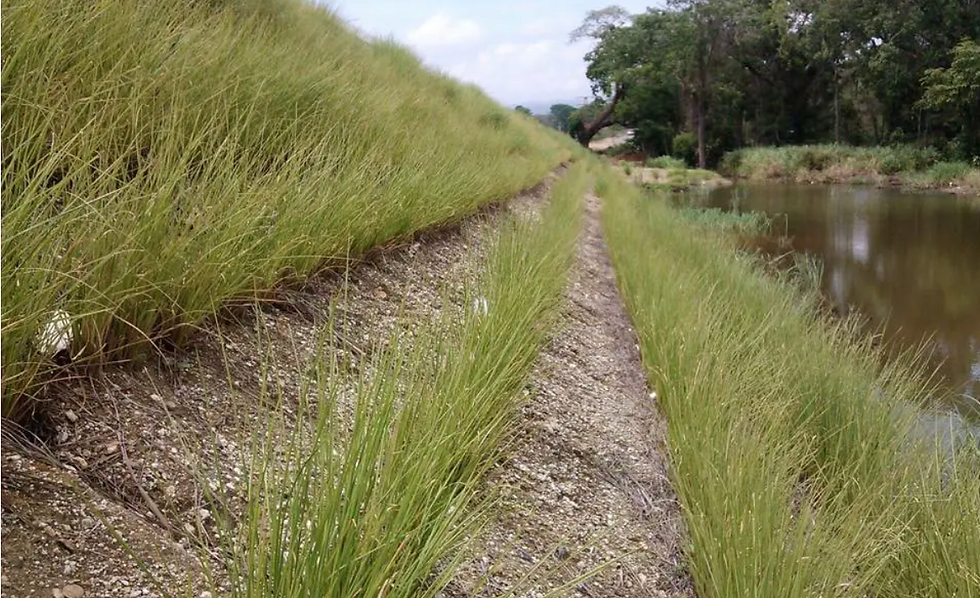
The Vetiver System (VS) for wastewater treatment is a nature-based, phytoremediation technology that uses Vetiver grass; either planted in constructed wetland beds or floated in pontoon panels on lagoon surfaces, to absorb, biodegrade, and immobilise pollutants from contaminated water.
First pioneered in Queensland, Australia during the 1990s by researchers at the Department of Natural Resources and Mines (now the Department of Environment and Science), the technology was documented in the landmark 2001 publication Vetiver System for Wastewater Treatment by Dr. Paul Truong and Barbara Hart. What began as an experiment treating landfill leachate has since evolved into one of the most versatile, low-cost, and globally validated water-treatment technologies available today.
Vetiver's suitability for this application is no accident. The plant's biology is almost purpose-built for the role:
Why Vetiver Works in Contaminated Water
Deep, dense root architecture. Vetiver's roots extend up to 3–4 metres into the substrate, creating an enormous surface area for microbial colonisation and nutrient uptake — far exceeding the root depth of conventional wetland plant species like common reed (Phragmites australis).
Exceptional pollutant tolerance. Extensive research across more than 100 countries confirms Vetiver tolerates elevated levels of salinity, sodicity, acidity, and a broad spectrum of heavy metals — including arsenic, cadmium, chromium, nickel, copper, mercury, lead, selenium, and zinc. Most conventional phytoremediation plants would die in conditions Vetiver thrives in.
Associated nitrogen-fixing mycorrhizae. Vetiver hosts nitrogen-fixing microorganisms in its root zone that enhance its capacity to metabolise ammonia and nitrates at rates that consistently outperform mechanical aeration systems.
Rapid biomass growth. Under nutrient-rich conditions — like sewage lagoons — Vetiver grows vigorously, channelling contaminants into harvestable above-ground biomass that can be repurposed as animal fodder, compost, or handicraft material, creating a true circular economy around waste treatment.
91%
COD REMOVAL RATE
Hybrid VS at Fez Wastewater Plant, Morocco (2025, ScienceDirect)
94.1%
NITROGEN REMOVAL
Hybrid Vetiver System, Fez, Morocco (2025)
97%
CIPROFLOXACIN REMOVAL
Constructed Wetland Study, NJ, USA (PMC, 2021)
89.7%
BOD REMOVAL (60 PLANTS/M²)
Ethiopia Study, Scientific Reports (2025)
Case Study: Guam's Floating Vetiver Experiment — A Pacific Island Blueprint
One of the most instructive early deployments of the Vetiver System for wastewater took place in southern Guam, documented in Pacific Rim Vetiver Network Technical Bulletin No. 2013/1 — a study conducted by Dr. Mohammad H. Golabi and Dr. Manuel Duguies of the University of Guam, published under the auspices of Thailand's Office of the Royal Development Projects Board.
The site: the Inarajan Sewage Treatment Plant (ISTP) — a four-cell aerobic lagoon facility built in 1989 and serving the villages of southern Guam. The challenge: nutrient levels (nitrogen and phosphorus) exceeding regulatory standards, threatening the marine ecosystems that underpin the island's tourism economy. The infrastructure was ageing; the marine habitat was degrading; the local community was suffering odour impacts and health concerns.

📍 FIELD CASE STUDY — SOUTHERN GUAM, 2008–2009
The Inarajan Floating Vetiver Experiment
Researchers constructed floating pontoon panels — 4×4-foot floats with 20 individual planting holes — and anchored them across Cell 2 of the treatment lagoon. Cell 1 continued operating with conventional mechanical surface aerators as a control. Vetiver tillers sourced from the University of Guam's Inarajan Research Station were planted from July through August 2008, coinciding with Guam's rainy season to maximise establishment success.
Over a 12-month monitoring period, water samples were collected bi-weekly and analysed for BOD, salinity, nitrates, nitrites, orthophosphates, and turbidity. Graduate students and agricultural extension workers managed the programme collaboratively.
The results were compelling: BOD, nitrite, and nitrate concentrations in the vetiver-treated cell were consistently lower than in the mechanically aerated control — demonstrating that floating vetiver panels were competitive with, and in several parameters superior to, expensive mechanical aerators that consume energy around the clock.
↓ BOD Vetiver cell consistently outperformed aerator cell
↓ NO₂ Nitrite levels significantly lower in vetiver cell
↓ NO₃ Nitrate reduction across 10 of 12 monitoring months
Zero Energy input required by the vetiver panels
The Guam study is significant not just for its results, but for its context. Guam represents a category of geography that faces outsized water-treatment challenges: island economies where tourism revenue depends directly on marine health, where infrastructure investment is expensive and technically complex, and where communities cannot afford the operational costs of conventional mechanical systems. This is precisely the environment where the Vetiver System offers its greatest comparative advantage.
The implications extend well beyond Guam. The Pacific Islands, Caribbean nations, Indian Ocean archipelagos, and coastal communities across Southeast Asia share these structural characteristics. The Guam model — floating vetiver panels on existing lagoon infrastructure — is a template that requires minimal capital, no energy, and builds local capacity through community-based plant propagation.
The Global Evidence Base: What the Peer-Reviewed Science Now Shows
Since the foundational Australian work of the 1990s and early 2000s, the scientific literature on Vetiver-based water treatment has expanded substantially. Here is a synthesis of what the current research tells us:
Municipal Wastewater: High-Density Planting Maximises Results
A 2025 study published in Scientific Reports (Nature Portfolio) evaluated Vetiver grass for municipal wastewater treatment in Bahir Dar City, Ethiopia. Three planting densities were assessed over a 9-week period. At 60 plants per m², the system achieved BOD removal of 89.7%, COD removal of 80.6%, and nitrogen removal of 60.5% — establishing that planting density is a critical design variable for performance optimisation.
Industrial Effluent: Olive Oil, Tanneries, and Electroplating
A 2025 hybrid system study conducted at a real wastewater treatment facility in Fez, Morocco (ScienceDirect) demonstrated that vetiver, when combined with trickling filters and activated sludge in a hybrid configuration, achieved 91% COD reduction, 87.5% phenol removal, and 94.1% nitrogen removal from polyphenol-rich olive oil production wastewater — one of the most chemically challenging industrial effluents in Mediterranean agriculture. Critically, vetiver maintained healthy growth throughout, even under high pollutant loads.
For heavy industrial applications, a Scientific Reports study on electroplating wastewater confirmed vetiver removed 61.1% of chromium and 95.65% of nickel — both toxic heavy metals associated with severe ecosystem and human health impacts.
Pharmaceutical Contaminants: An Emerging Frontier
Perhaps the most consequential frontier in Vetiver water-treatment research is its efficacy against pharmaceutical contaminants — a class of emerging pollutants that conventional wastewater treatment plants (WWTPs) are structurally ill-equipped to address. A peer-reviewed constructed wetland study (PMC, National Institutes of Health, 2021) found vetiver removed 93% of ciprofloxacin and 97% of tetracycline from secondary wastewater effluent, simultaneously achieving 93% nitrogen and 84% phosphorus removal. This is enormously significant given the global antibiotic resistance crisis.
WHY THIS MATTERS FOR GLOBAL HEALTH
Antibiotics discharged into waterways from pharmaceutical manufacturing, hospitals, and agriculture are driving antimicrobial resistance — projected by the WHO to become the world's leading cause of death by 2050. Conventional WWTPs cannot remove these compounds. Vetiver can. This positions the Vetiver System at the intersection of water treatment, public health, and one of the defining challenges of the 21st century.
High-Strength Industrial Wastewater: Tannery Effluent in Ethiopia
A constructed wetland study in Ethiopia (PMC, 2021) using vetiver on tannery effluent — among the most demanding industrial wastewater streams — recorded BOD removal of 91.9%, COD removal of 96.3%, total phosphorus removal of 92.2%, and chromium reduction of 97% at a hydraulic retention time of just 9 days. The planted beds significantly outperformed unplanted controls at a statistical significance of p < 0.01.
Vetiver vs. Conventional Treatment: An Honest Comparison
FACTOR | VETIVER SYSTEM | MECHANICAL AERATORS | CHEMICAL TREATMENT |
Capital Cost | Very Low | High | High |
Operating Cost | Very Low / Zero Energy | Ongoing (electricity 24/7) | Ongoing (chemical inputs) |
Nitrogen Removal | Up to 94% | Moderate | Variable |
Heavy Metal Removal | Yes (multiple metals) | No | Partial |
Antibiotic Removal | Up to 97% | No | No |
Improves Over Time | Yes (as plant matures) | Degrades (mechanical wear) | Static |
Secondary Outputs | Biomass (fodder, compost) | None | Chemical sludge |
Scalability | Highly scalable, modular | Requires engineering | Complex logistics |
Island / Remote Suitability | Excellent | Poor (supply chain dependency) | Poor |

The Strategic Opportunity: A $652 Billion Market Crying Out for Nature-Based Solutions
The global water and wastewater treatment market, currently valued at approximately $347 billion, is projected to reach $652 billion by 2034 — expanding at a CAGR of 6.5%. The fastest-growing segment is Asia-Pacific, accounting for 36% of the global market and growing at 8.5% annually, driven by India, China, Vietnam, Indonesia, and the Pacific Rim's rapidly urbanising population.
Within this, the decentralised water treatment market — the most directly relevant to Vetiver applications — was valued at $17.45 billion in 2024 and is projected to grow at 12% CAGR to nearly $50 billion by 2033. The Middle East and Africa, and island developing nations, are specifically identified as high-growth regions due to inadequate centralised infrastructure and extreme cost constraints.
This is not a niche. This is a structural market gap that the Vetiver System is uniquely positioned to fill and one that Vetiverse.org is positioned to lead globally as the knowledge and implementation expert for VS-based water solutions.
"About 80% of wastewater is discharged into the environment without treatment — reaching 95% in developing countries. These communities need low-cost, locally-managed, proven solutions. Vetiver is that solution."
— Adapted from WHO / World Bank Global Wastewater Data, 2023–2024
How to Implement the Vetiver System for Wastewater: A Practical Guide
The Vetiver System for wastewater treatment can be deployed in several configurations depending on site conditions, budget, and treatment objectives:
1. Floating Panel System (Pond / Lagoon Applications)
As demonstrated in Guam and widely deployed across Southeast Asia, vetiver tillers are established in pots or mesh panels and floated on existing lagoon surfaces. The roots grow directly into the water column, maximising contact with pollutants. This is the most retrofit-friendly approach — requiring no site engineering and compatible with existing wastewater ponds.
2. Constructed Wetland (CW) Beds
Vetiver is planted at high density (40–60 plants/m²) in engineered wetland beds, either horizontal or vertical flow, through which wastewater is channelled. This configuration is suitable for larger-volume applications including municipal treatment and industrial effluent polishing. Research consistently shows 60 plants/m² optimises nutrient and BOD removal.
3. Buffer Strip / Overland Flow Systems
For agricultural runoff and non-point source pollution, vetiver hedgerows intercept and filter nutrient-laden water across sloped terrain. This is the classic VS application extended to water quality management — simultaneously preventing erosion and treating runoff before it reaches receiving waterways.
4. Hybrid Systems
The most promising emerging configuration combines vetiver with complementary biological or physical processes — as demonstrated in Morocco's hybrid system integrating trickling filters, planted filters, and activated sludge with vetiver's phytoremediation capacity. Hybrid systems can address higher pollutant loads and more complex effluent compositions.
Honest Limitations: What the Science Also Tells Us
The Guam study provides a useful lesson in scientific transparency — one that strengthens rather than undermines the case for the Vetiver System. The researchers identified duckweed competition as a significant confounding variable, particularly for phosphorus removal. Duckweed growing on the lagoon surface created anaerobic conditions that interfered with phosphate uptake measurements.
This is an implementation lesson, not a fundamental limitation: site design should incorporate duckweed management protocols where warm, nutrient-rich open water is involved. It also highlights the importance of proper ecological site assessment before deployment — a service that Vetiver practitioners and knowledge networks are well-placed to provide.
Additional considerations include performance variation with climate and season, the time required for plant establishment (typically 3–6 months to full performance), and the need for periodic biomass harvesting to remove captured nutrients from the system.
Vetiverse: The Global Hub on Vetiver System Knowledge
Vetiverse.org (formerly Veticon Consulting Australia founded by Dr. Paul Truong) serves as open-access knowledge hub for the Vetiver System — aggregating decades of international research, field-case documentation, practitioner experience, and community knowledge from the global vetiver network.
For municipalities, development agencies, agricultural extension officers, environmental engineers, and rural communities seeking guidance on VS-based wastewater treatment implementation, Vetiverse.org offers a uniquely authoritative point of reference — bridging peer-reviewed science, proven field practice, and the lived experience of practitioners across 100+ countries.
Whether you are designing a floating vetiver system for a Pacific Island community, evaluating VS for an industrial effluent challenge, or seeking to connect with implementation partners, the Vetiverse network exists to accelerate that process.
🌿 CONNECT WITH THE GLOBAL VETIVER COMMUNITY
Vetiverse maintains active relationships with the Pacific Rim Vetiver Network (PRVN), vetiver.org, and practitioner communities across Southeast Asia, Africa, Latin America, and Oceania. If you are working on a water treatment challenge that vetiver could address, we want to hear from you.
Share this article: LinkedIn
References & Further Reading
Golabi, M.H. & Duguies, M. (2013). Application of the Vetiver System for Wastewater Treatment: An Innovative Nutrient Removal Technology for Sewage Water Treatment in Southern Guam. PRVN Technical Bulletin No. 2013/1. Office of the Royal Development Projects Board, Bangkok, Thailand.
Truong, P.N. & Hart, B. (2001). Vetiver System for Wastewater Treatment. PRVN Technical Bulletin No. 2001/2. ORDPB, Bangkok, Thailand.
Lewoyehu, M. et al. (2025). Evaluating the efficiency of vetiver grass (Vetiveria zizanioides) for municipal wastewater treatment in Bahir Dar City, Ethiopia. Scientific Reports (Nature Portfolio). DOI: 10.1038/s41598-025-22576-0
Ghazali, N. et al. (2025). A new hybrid Vetiver system for the treatment of polyphenol-rich wastewater from olive oil production. ScienceDirect / Science of the African. DOI: 10.1016/j.sciaf.2025.e03079
Riyadi, F.A. et al. (2021). Phytoremediation of electroplating wastewater by vetiver grass (Chrysopogon zizanioides L.). Scientific Reports, 11, 14808. DOI: 10.1038/s41598-021-93923-0
Yadav, A.K. et al. (2021). Removal of antibiotics and nutrients by vetiver grass from a plug flow reactor based constructed wetland model. PMC / MDPI Water. PMC8071396
Bekele, A. et al. (2021). High strength wastewater reclamation capacity of vetiver grass in tropics: The case of Ethiopia. PMC. PMC8637771
Nguyen, M.K. et al. (2023). Application of vetiver grass for organic matter removal from contaminated surface water. Bioresource Technology Reports, 22. DOI: 10.1016/j.biteb.2023
Precedence Research. (2025). Global Water and Wastewater Treatment Market Report 2025–2034. precedenceresearch.com
Straits Research. (2024). Decentralized Water Treatment Market: 2025–2033 Forecast. straitsresearch.com
WHO. (2023). Drinking Water Fact Sheet. who.int/news-room/fact-sheets/detail/drinking-water
Join the Vetiver Network
Connect with practitioners, researchers, and implementers across 100+ countries through the Vetiverse.org/contact
Vetiverse.org — Global Vetiver System Knowledge & Advocacy,
Formerly Veticon Australia.
The Vetiver Network International Representative vetiver.org.
© 2026 Vetiverse.
Content available for educational use with attribution. Always cite primary sources.


Comments